
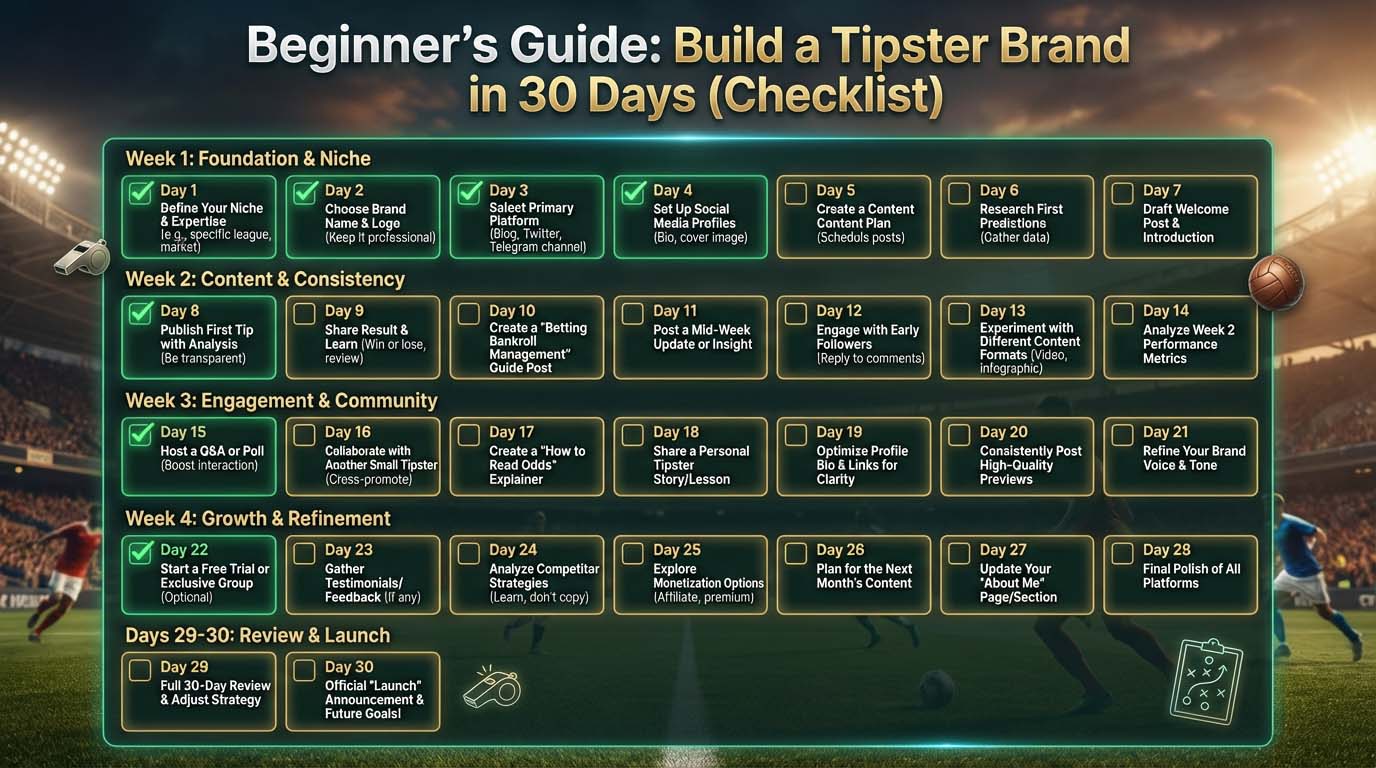
Beginner’s Guide: Build a Tipster Brand in 30 Days (Checklist)
What a “Tipster Brand” Actually Is (and Why Most Fail Early)
A tipster brand is not just a feed of picks. It is a repeatable promise: who you help, what markets you cover, how you think, and what people can reliably expect from your content.
If you want to become a tipster with staying power, you need a brand that reduces uncertainty for followers and sets boundaries for you.
Most beginners struggle because they try to start tipster brand activities before deciding what they stand for. They post sporadically, switch sports weekly, and treat “results” as the only form of marketing. In reality, the early win is clarity: a consistent niche, a transparent process, and a simple system for publishing.
This guide is designed as a 30-day build, with a practical checklist you can turn into a downloadable PDF for email capture. The goal is to help you start tipster brand operations like a small media business: audience-first, process-led, and measurable.
Day 1–3: Choose a Niche You Can Defend
To become a tipster responsibly, start with a niche you can cover with discipline. “All sports” is rarely a niche; it is usually a symptom of avoiding commitment. Your niche should be narrow enough to build authority, but large enough to sustain content for months.
Use a simple filter: knowledge, access, and repetition.
- Knowledge: You understand the competition format and market mechanics.
- Access: You can watch, read, or track relevant information consistently.
- Repetition: The market has frequent events so your brand stays active without forcing picks.
Checklist
- Pick one primary sport and one primary market type (for example, totals, props, or match odds) to simplify your early messaging.
- Write a one-sentence audience statement:
“I help [type of follower] find [type of edge] in [market] with a [style of analysis].” - Decide what you will not cover. Constraints are part of a credible identity when you start tipster brand efforts.
Day 4–7: Draft a Tipster Business Plan (Lean, Not Corporate)
A tipster business plan is your operating system. Keep it lean: one page is enough. The point is not to impress anyone; it is to reduce decision fatigue. When you become a tipster with a plan, you publish more consistently and make fewer reactive changes.
The 6 Blocks to Include
- Brand promise: what you do, for whom, and what “good content” looks like.
- Content cadence: how many posts per week, and which formats (previews, recaps, live notes).
- Offer ladder: free content, email list, then paid (if/when you monetize).
- Workflow: research time, writing template, publish schedule, record keeping.
- Risk and compliance: responsible gambling language, no unrealistic claims, clear boundaries.
- Metrics: what you will track weekly (growth, engagement, and process consistency).
In your tipster business plan, define your minimum viable proof. Early on, that proof is often consistency and transparency, not perfection. You are building trust in your method while you start tipster brand assets and systems.
Set Your Brand Voice and Rules
Decide how you write: analytical, calm, and specific. Create rules you can keep, such as: explain the logic, avoid hype language, and never pressure followers. If you want to become a tipster long-term, your tone is a risk-control tool as much as a marketing choice.
Day 8–12: Build Your Minimal Brand Stack (Fast and Clean)
You do not need complex tech to start tipster brand operations. You need a consistent name, a basic visual identity, and one place that you control where people can subscribe. Social platforms can change; your email list is the stable asset.
Your Non-Negotiables
- A simple landing page that explains who you are, what you cover, and how often you post.
- An email capture form offering a downloadable PDF: “30-Day Tipster Brand Checklist.”
- A short “About” paragraph with your niche, process, and commitment to responsible behavior.
Keep your stack minimal: one primary social channel, one email tool, and one home base. Your tipster business plan should specify which channel is primary so you do not fragment your attention.
If you plan to become a tipster professionally, create a repeatable template for posts: headline, market, rationale, and a short note on uncertainty. A consistent template makes your content easier to scan and easier to trust.
Day 13–18: Create Content That Signals Process (Not Just Picks)
In the early stage, your job is to show how you think. Anyone can post selections; a brand is built by explaining decisions in a way that feels steady and falsifiable. If you want to start tipster brand momentum, prioritize posts that teach followers what you look for.
If writing consistently is your main bottleneck, an AI Writer for tipsters can help create structured blog posts and match predictions—either with or without web data—while keeping your reasoning transparent.
Three Content Types to Rotate
- Framework posts: how you approach a market, what variables matter, what you ignore.
- Previews with structure: context, matchup or market logic, and the scenario where you would pass.
- Recaps that show learning: what worked, what didn’t, and what you’ll adjust next time.
A strong tipster business plan includes a definition of a “no bet” day. Publishing a disciplined pass can be more brand-building than forcing a pick. This is one of the clearest signals that you aim to become a tipster with professional standards.
Day 19–24: Turn the 30 Days into a Repeatable Weekly System
By this point, you should be able to run your workflow without improvising. The brand grows when your audience knows what happens on certain days and what “quality” looks like. Your goal is to start tipster brand consistency first, then scale.
Weekly Operating Rhythm
- Research day: prepare notes, shortlists, and a watchlist of upcoming events.
- Publishing days: post at a predictable time window so your audience can build a habit.
- Review day: recap outcomes and update your internal notes and templates.
This rhythm belongs inside your tipster business plan. It makes your content output less emotional and more operational, which is critical if you plan to become a tipster who can handle variance without changing identity every week.
Also refine your email capture: the PDF should mirror your checklist and include a simple next step, such as replying with their niche and platform so you can segment and respond. This keeps your start tipster brand funnel focused on conversation, not just sign-ups.
Day 25–28: Decide How (and Whether) to Monetize Yet
Monetization is not required in month one. But you should decide what the path could be so your brand does not drift. A tipster business plan works best when it includes a clear offer ladder, even if you delay the paid tier.
If you decide to monetize later, using a hosted platform like OwnTheGame can simplify subscriptions, posting, and transparent stats, without forcing you into daily pick pressure.
Common models include: a free public feed plus a paid subscription for deeper analysis; a paid community; or a premium email list. Whatever you choose, keep the offer aligned with your niche and workflow. If you become a tipster and immediately promise constant picks, you may trap yourself in a schedule that harms quality.
Set Boundaries in Writing
- What your paid tier includes (and what it does not include).
- Your posting frequency range, not an absolute daily promise.
- A clear reminder that followers are responsible for their own decisions and budgets.
When you start tipster brand monetization, price should reflect effort and clarity, not hype. A smaller, aligned audience often beats a larger audience that expects entertainment over analysis.
Day 29–30: Launch, Measure, and Iterate Without Losing Trust
The final step is a clean “launch moment” that consolidates everything you built. Publish a pinned post or introductory email that explains: your niche, your posting cadence, your template, and how to get the PDF checklist. This is where your start tipster brand work becomes a coherent story.
Measure What Matters (Week 1)
- Consistency: did you post as planned?
- Engagement quality: questions and replies (not just likes).
- List growth: email sign-ups from the checklist.
Avoid obsessing over short-term outcomes you cannot control. Your tipster business plan should keep you anchored to process metrics.
Monthly Review (Stay Credible)
- Keep: formats and topics that produce thoughtful engagement.
- Cut: content you publish only out of pressure or habit.
- Change: one variable at a time (cadence, niche focus, or content templates).
If you want this guide to function as an email magnet, convert the checklist paragraphs into a one-page PDF and add a short worksheet: niche statement, weekly rhythm, and posting template. That reinforces your positioning and keeps your start tipster brand journey structured beyond day 30.