
What Data to Check Before You Publish a Pick (Pro’s Checklist)
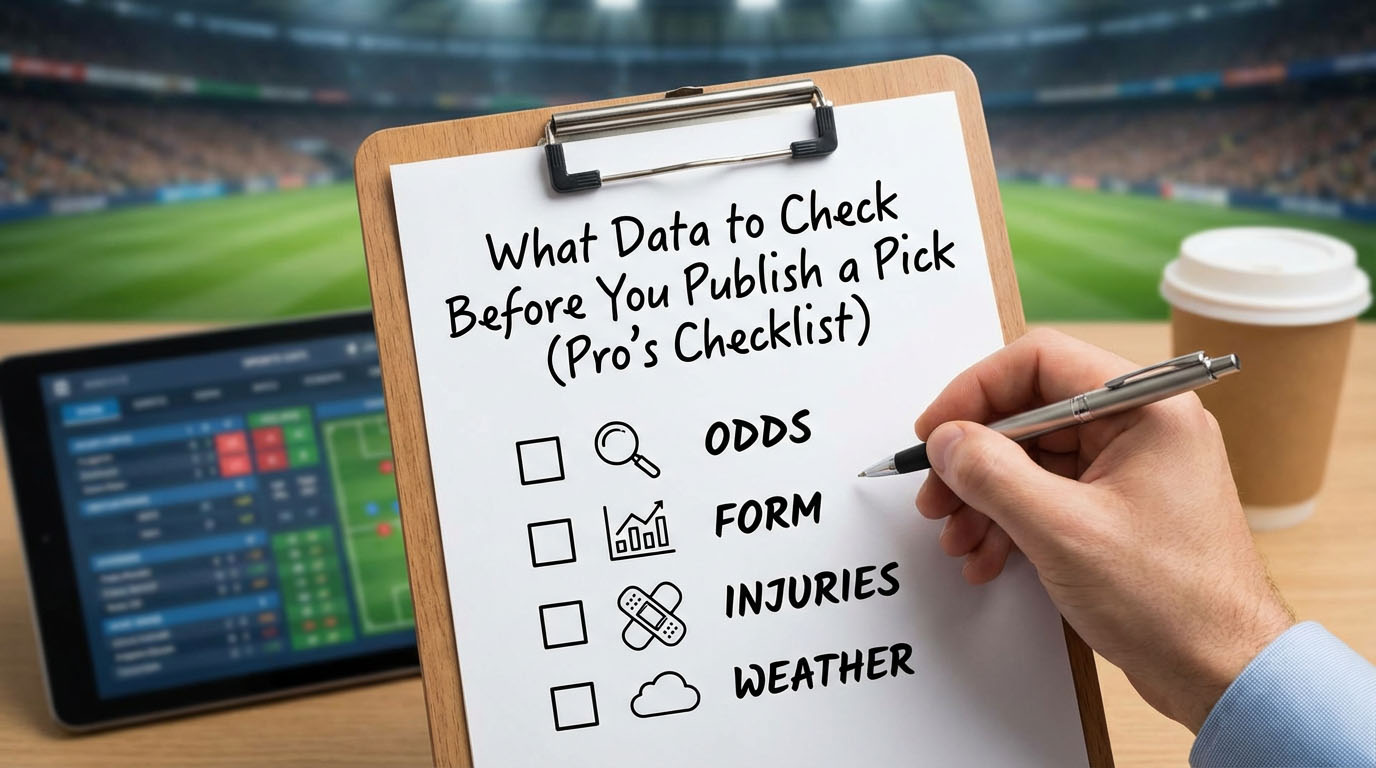
If you’ve ever posted a pick and then watched the game unfold thinking, “Wait… why is their best striker not even on the bench?” – you’re not alone.
Most “bad picks” aren’t bad because the idea was terrible. They’re bad because one key piece of information was missing (or outdated) right before publish time.
This post gives you a simple, repeatable checklist you can run in minutes before you publish. It’s not about fancy models or trying to sound smart. It’s about checking the data points that most often flip a bet from solid to shaky and building a process you can trust.
Why a checklist matters (even if you “know what you’re doing”)
Pros don’t rely on vibes. They rely on process.
A checklist helps you:
- avoid obvious mistakes (lineups, injuries, wrong market)
- stay consistent when posting often
- reduce emotional picks (tilt, recency bias, fan bias)
- publish with confidence because you checked the inputs
Think of it like a pilot’s pre-flight. The plane might be fine… but they still check.
The Pro’s Pre-Pick Checklist
Use this in order: market → team news → context → matchup → final value decision.
1) Market reality check: odds, line, and movement
Before anything else, confirm you’re analyzing the current price.
Check:
- current odds (not the odds from earlier)
- opening odds vs current odds (movement tells a story)
- line changes (handicaps and totals are especially sensitive)
- where the move happened (sharp books vs soft books)
Why it matters:
- if the price moved strongly against your idea, your edge may be gone
- if the price moved in your favor, you might still have value, but confirm why it moved
Quick rule: if you can’t explain the move, pause and re-check injuries, lineups, and news.
2) Team news: injuries, suspensions, and rotation risk
This is the #1 reason good picks turn into regret.
Check:
- confirmed injuries (not rumors)
- suspensions (cards, bans, roster rules)
- rotation risk (cup match next, congested schedule, coach patterns)
- goalkeeper changes (often overlooked, often huge)
What to look for:
- missing players in key roles (CB pairing, DM, main creator, striker)
- replacements that change the tactical shape
- returning players who lift the whole team
If your pick depends heavily on one player, say it clearly and have a plan if they’re benched.
3) Lineups and timing (when possible)
If you’re publishing close to kickoff, lineups are gold.
Check:
- the official starting lineup
- formation and role changes (3-5-2 vs 4-3-3 can change everything)
- late scratches (especially in sports where availability changes fast)
If lineups aren’t out yet, be honest about assumptions. If uncertainty is high, consider reducing stake or waiting.
4) Current form (but use the smart version)
Form is not “last 5 results.” That’s surface-level and often misleading.
Better signals include:
- underlying performance (xG, shots, big chances, field tilt – if available)
- home vs away splits
- quality of opponents
- style consistency (are they creating the same type of chances every week?)
What you want to answer:
- is the team playing well even when results vary?
- or are results good but performances shaky (lucky goals, overperforming finishing)?
5) Motivation and context: what does the match mean?
Motivation is real, but it must be grounded – not narrative fiction.
Check:
- league position and stakes (title race, top-4, relegation battle)
- must-win vs can-rotate situations
- derby/rivalry intensity
- travel situation (especially around international games)
- coaching pressure (some teams change approach under stress)
Watch out for: “they should care” vs “they must care.” Those are not the same.
6) Tactical matchup: who gets what they want?
This is where picks become high-quality.
Ask:
- does Team A’s strength directly attack Team B’s weakness?
- can Team B neutralize Team A’s main threat?
- are there specific mismatches (pace out wide, aerial weakness, press resistance)?
Examples of clear matchup edges:
- strong set-piece team vs opponent that concedes many set pieces
- high press vs shaky ball-playing back line
- fast transition team vs slow center-backs
You don’t need to be a tactics expert. Just answer: “How will this game likely play out, and why?”
7) Schedule and fatigue: the hidden performance killer
Fatigue shows up as:
- slower pressing
- weaker duels late in games
- sloppy passing
- more injuries
Check:
- days of rest
- travel distance and time zones
- minutes load for key players
- squad depth (can they rotate without losing quality?)
When a team played 72 hours ago and travelled, it can affect tempo, intensity, and second-half performance, which matters for sides, totals, and in-play angles.
8) Weather and pitch conditions
This is ignored far too often, and it can flip totals or props.
Check:
- heavy rain/snow (slower game, fewer clean chances)
- wind (affects long balls, set pieces, shooting)
- heat (lower intensity, slower tempo)
- pitch quality (some venues consistently play “heavy”)
Weather is especially relevant for totals, corners, crossing-based teams, and long-shot props.
9) Head-to-head (H2H): use it carefully
H2H is not predictive by itself, but it can support your analysis if you interpret it correctly.
Use H2H only when:
- squads aren’t completely different
- coaching styles are similar
- the matchup pattern makes sense tactically
Avoid H2H when:
- new coach, new system
- major roster changes
- the “trend” is based on just 2–3 games
Treat it as a small supporting signal, not the foundation.
10) The final value test: is the price still good?
This is the moment of truth.
Ask:
- would I still take this at slightly worse odds?
- if the odds dropped, did my edge disappear?
- what’s my fair price (even roughly)?
A simple idea: if odds now reflect the true probability more closely than before, your value may have shrunk. Pros pass a lot. Passing is a skill.
11) Publish like a pro: clarity beats complexity
If you’re publishing picks for an audience, having a structured platform matters as much as the analysis itself. With OwnTheGame, you can post picks in a clean, professional format, manage subscription-based access, and keep your betting content consistent and easy to follow — without manual work or messy spreadsheets.
If you publish picks (especially to an audience), your write-up should always include:
- what you’re betting (market + odds)
- why it’s value (core reason in 1–2 sentences)
- key data points (injuries, form indicators, matchup edge)
- risk note (what could go wrong)
- consistent staking (units, not emotions)
This builds trust and keeps your process honest, even when results swing.
Copy/paste “publish-ready” pick template
Pick:
Odds:
Reason (1–2 lines):
Supporting data:
Risks:
Stake:
Final thought
The goal of this checklist isn’t to make betting “certain.” Nothing is certain. The goal is to stop losing to avoidable mistakes, the late injury, the rotated lineup, the weather shift, the market move you didn’t notice.
Run the checks. Publish fewer but better picks. Over time, that discipline shows up in your results and in the trust your audience puts in you.